Talk to Acro and hear where your time is going.
Acro is our voice AI. Give him about nine minutes on how your business actually runs. When you hang up, he writes your Automation Intelligence Brief: what is worth automating and what we would hand off first.
A vendor charges about $1,200 for the same analysis. Here it is free, and the brief is yours to keep.

Press start. He picks up.
Fill in where the brief should go, allow the microphone, and talk. Interrupt him. Ask him something nobody would script. That is the test.
Your brief arrives as a link, by email, the moment it is ready.
Acro is the product, pointed at you.
He runs our own funnel, four in the morning included: he asks, listens, takes the notes and hands off. We build the same kind of voice AI for clients, to answer their phones, qualify their leads and onboard their customers.
Listen for the pause before he answers. Does he remember what you said ninety seconds ago? Does he sound like he is reading, or thinking?
Pay attention to how it feels. That is how it will feel to your customers.
You talk. He writes it up.
You talk
Describe how the business runs. He builds each follow up on what you actually said.
The brief lands
He turns the call into a written brief, built on your numbers and your own words.
You decide
Walk through it with Zack on a call, or keep it and get on with your day.
Stay on and the brief gets deeper.
See the brief before you make the call.
Yours is written from your own call, about your business and nobody else's.
-
The headline number
What the current setup costs you, on the cover.
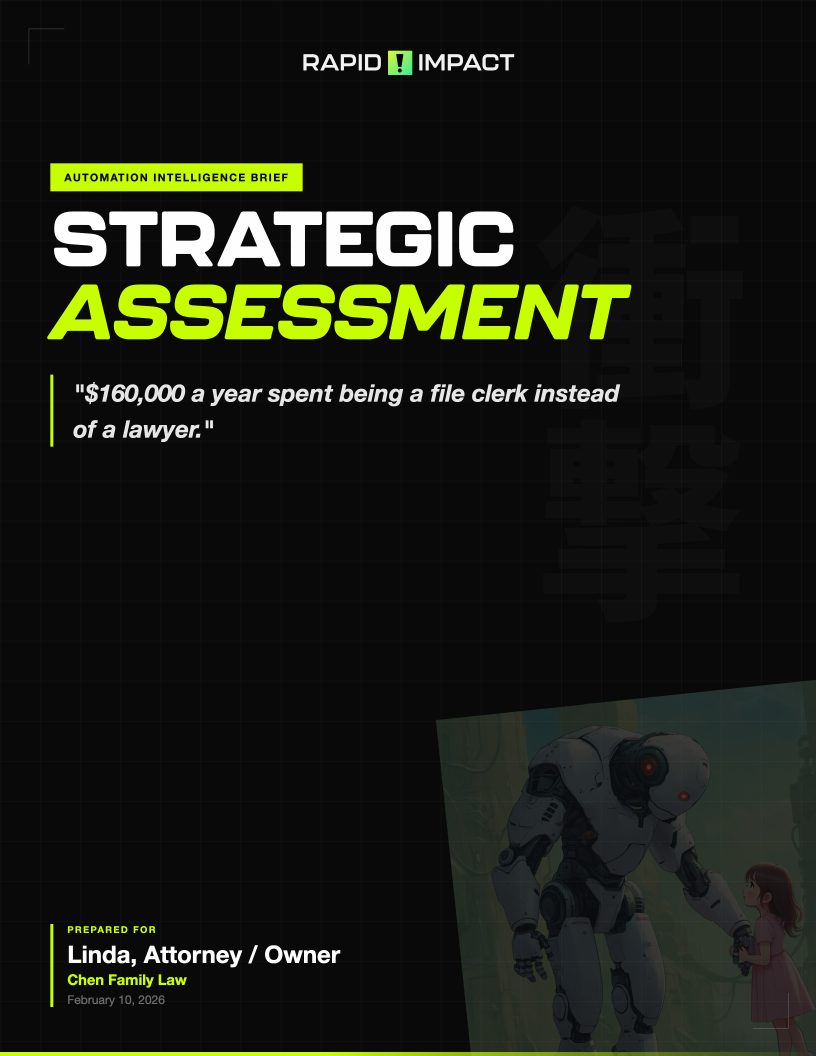 (PDF, opens in a new tab)
-
What we heard
Your situation, in your own words.
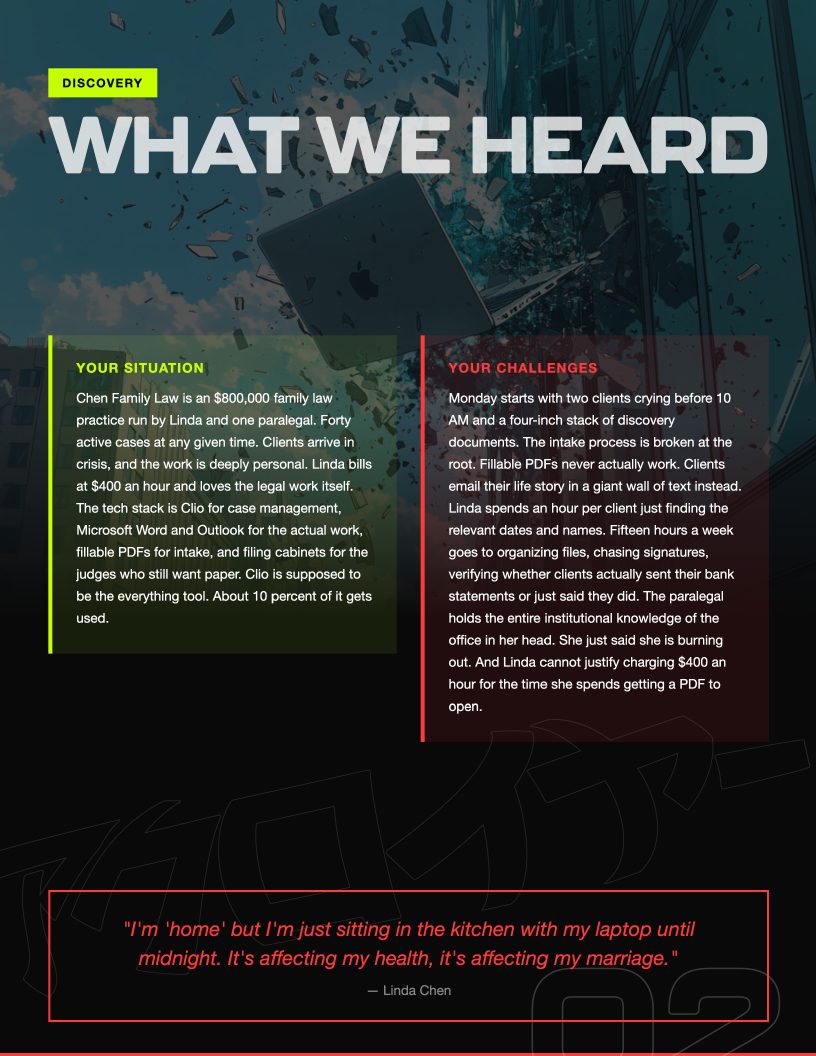 (PDF, opens in a new tab)
-
The cost of leaving it
Itemised from the numbers you gave, so you can check the math.
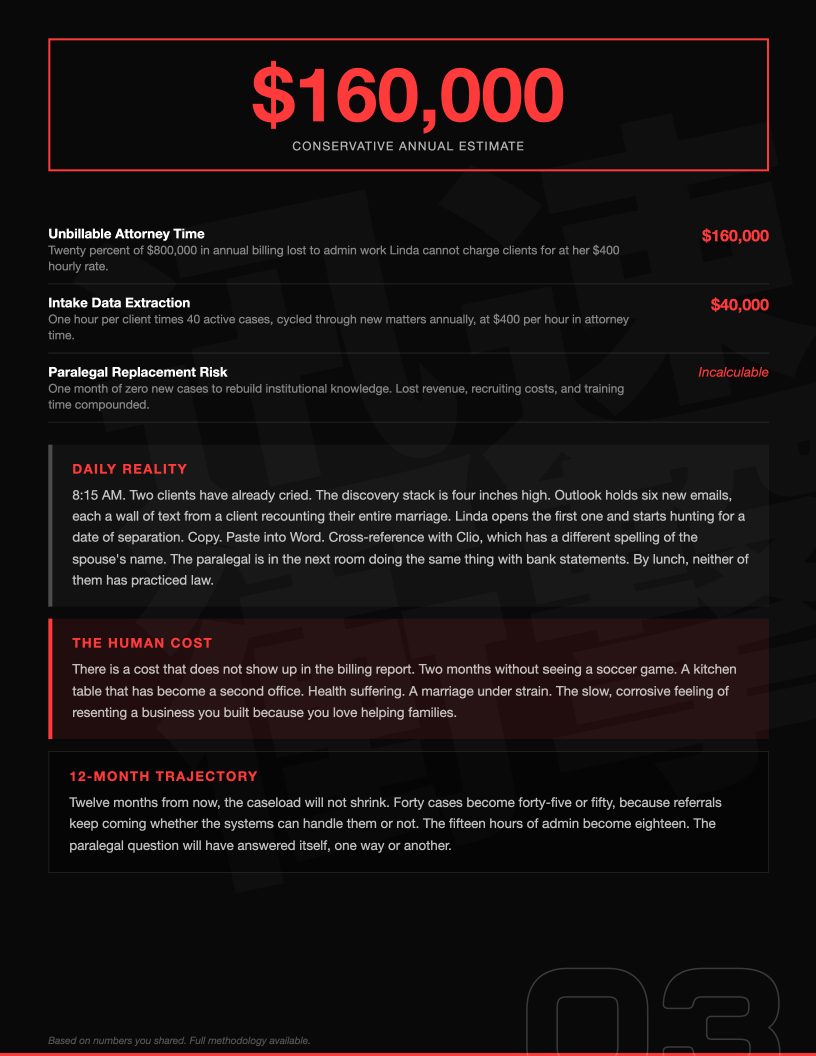 (PDF, opens in a new tab)
-
What we would hand off first
The system to build first, and why.
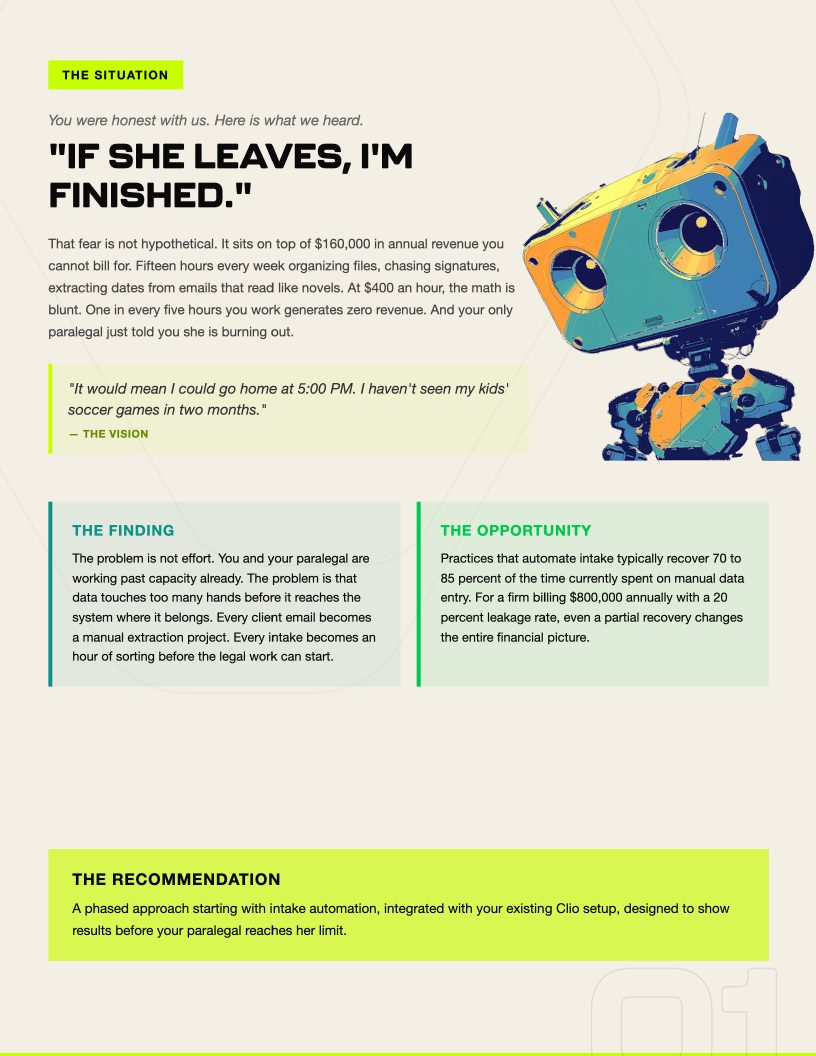 (PDF, opens in a new tab)
A sample brief for a fictional family law practice.
Vague in, generic out.
The brief is only as specific as the call. Tell Acro that invoicing eats a day every week because three people touch it, and you get a brief with your name on it. You can come unprepared. It helps to say the unflattering part out loud.
Worth bringing up
- What the business does, and who pays you for it.
- The tools you run on, including the spreadsheet nobody admits to.
- Where the week goes, and which parts are still manual.
- What you already tried, and why it did not stick.
- What breaks when you take a week off.
Follow the tangents. The useful part is rarely the first answer.
Before you press start.
Is this a real AI, or a recording with branches?
Real, and live. He composes each answer while you talk, so when you interrupt or wander off topic, he follows.
Why does the form ask for my phone and email?
Your email is where the brief goes, along with any booking confirmation. Your phone gets a single text, a one-time code that verifies the number. We never sell either, and the privacy policy has the rest.
Is it actually free?
Yes. You pay nothing, now or halfway through, and the brief is yours to keep whether or not you hire us.
My operation is a mess. Is it worth doing?
That is the best reason to do it. The useful material lives in the workarounds, the double data entry, and the process only one person remembers.
What do I need on my end?
A browser, a microphone, and somewhere you can talk out loud. It works on a phone. Headphones help, so he hears you and not himself.

Put Zack on the calendar, or ask Acro now.
You leave with the brief either way.
Twenty minutes, on the calendar.
About nine minutes, any hour.
If everything in your business still runs through you, booking the audit is the right decision.
We work with founders building something that deserves to last, and we cap at 20 clients so the work stays senior.